
A little over a year ago my husband and I decided to make the move back to Oregon after living in California for the past 12 years. We agreed that we wanted to leave suburban life for a while and try living a simpler life in the city. We have now been living back in Oregon for over a year and just moved into a condo we recently purchased in the Pearl District. Along with a convenient location comes a smaller living space for us.
It’s been liberating to donate, toss, and gift, years of accumulated items which had been stored in a home we had lived in for over 10 years. We now live in a 800 sqft condo, with a highly active toddler. You got that right, 800, not 1,800 sqft.
All this leads me to doing a post regarding how to create learning environments for children in small living spaces. It takes some creative thinking and certainly evaluating the importance of every item in the space.
Key tips for creating learning spaces for children (regardless of the size of the space) should include:
-Low accessibility to toys and learning materials. (Mounting shelves and storage at a level your child can easily access.)
-Consider making as many of the toys visible as possible. This may seem counter-intuitive, what’s a toy box for then right? The more visible and accessible an item is, the more apt a child is inclined to use it. Don’t get me wrong, baskets certainly have their place in a child’s environment, for all those toys that consist of multiple pieces (ie: block sets, Legos, Tinker Toys, etc.)
-Only have toys that look appealing. Chances are, if it looks nice/fun/interesting to you, it will to your child as well.
-Often the importance of having a quiet, soft, cozy, space for a child gets overlooked; it is important for this space to exist somewhere. If more then one child is in the living space, it acts as a location where a child can go if they feel overstimulated, or want some downtime. It is also a location where reading and looking at books can take place.

Tips for setting up children’s environments in particularly small spaces:
-Think multipurpose everything. Have a toddler table? That is the meal table, art table, train table.) Don’t have space for a separate toddler table but do have a coffee table? Perfect! Your coffee table is the art and activity table, many modern coffee tables even have storage. Keep whatever art materials you use regularly for your child in there and it makes for easy clean up.


-Mounting small cubical shelving allows for you to place items of different sizes in, below, and above the shelves. Taller items can fit below, and above. My favorite style of shelving to use for infant and toddler environments the Ikea TROFAST wall storage.
http://www.ikea.com/us/en/catalog/products/50171122/
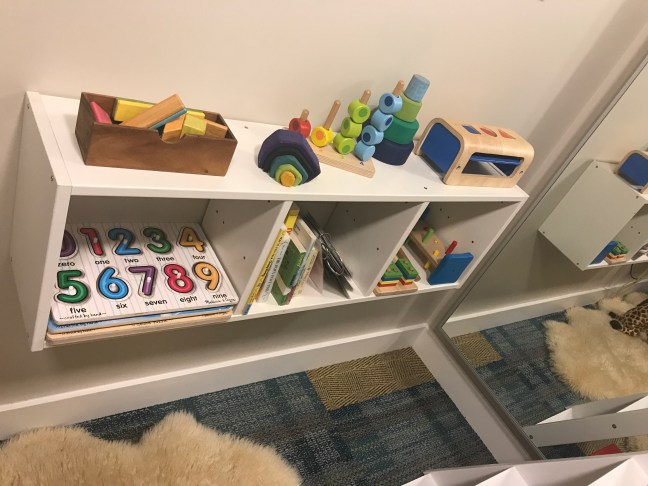
I leave the plastic mounting hardware for baskets off and just use the shelving unit. The reason why it’s so fantastic for small spaces is it’s only around 11 inches wide. When your child is an infant, you can set the shelving on the floor, as they are sitting up, you can mount the shelving on the wall at a very low level. As your child starts to learn to pull themselves up, this also acts as a safe way for them to pull up without the risk of something falling over. As they become toddlers, mount it even higher to make space for all those larger toy items they start to enjoy.
-It’s just a hallway, or is it? Consider making spaces that would normally be a through space, usable. We happen to have a really large hallway, and it’s full functioning.

-Use your window sill to display toys or activities, if you don’t have one, consider setting something up right in front of the window. Wherever the best natural lighting in your house, your child will be drawn to doing things in that space. What is even better about it, is they often look out the window more often as well when an activity is happening there. In our space, the window overlooks some really beautiful mountains, but also some pretty awesome cars.


 Play Space Early Learning Center